
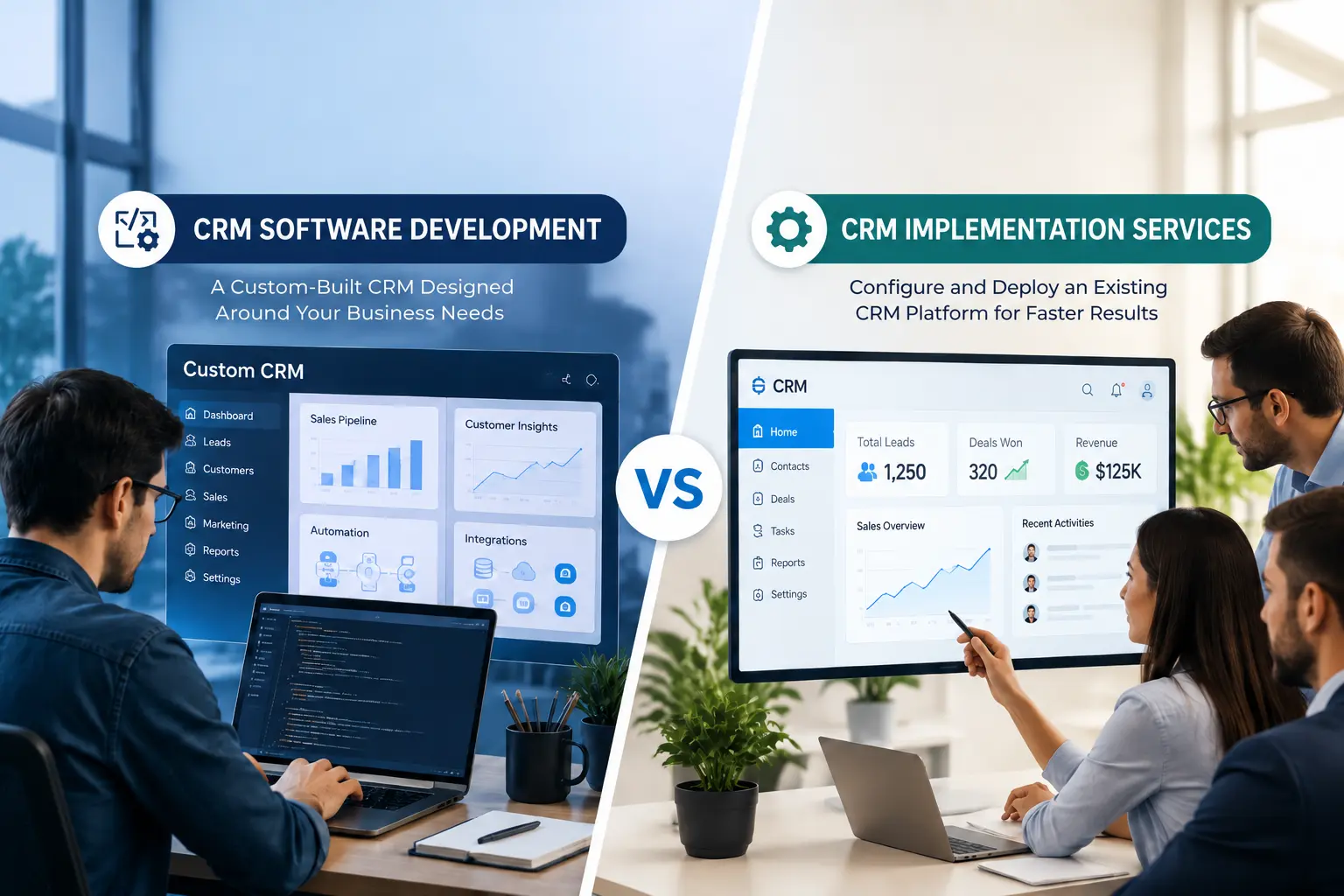
Customer relationships are becoming increasingly complex. Businesses now manage leads, customer conversations, sales pipelines, marketing campaigns, support requests, customer data, automation workflows, and analytics across multiple platforms.
A Customer Relationship Management (CRM) system helps organize these activities, but choosing the right CRM approach is where many organizations face challenges.
Should a business build a custom CRM software solution designed around its exact processes? Or should it choose CRM implementation services to configure and deploy an existing CRM platform?
The answer depends on business goals, operational complexity, budget, scalability requirements, integration needs, and long-term technology strategy.
Many organizations make the mistake of comparing CRM development and CRM implementation as competing options. In reality, they solve different business problems.
CRM implementation focuses on adapting an existing CRM platform to support business operations.
CRM software development focuses on creating a customized CRM system when existing platforms cannot meet specific requirements.
This guide explains the differences between CRM software development vs CRM implementation services, including costs, benefits, limitations, timelines, use cases, and how businesses can choose the right approach.
CRM software development is the process of designing, building, testing, deploying, and maintaining a CRM system specifically around a company’s unique requirements.
Instead of adjusting an existing CRM platform, businesses create a solution where features, workflows, dashboards, integrations, permissions, and user experiences are built according to their operational model.
A custom CRM may include:
Businesses often consider custom CRM development when standard CRM platforms require too many compromises or cannot support complex processes.
Companies with unique sales models, specialized industries, strict compliance requirements, or complex internal workflows may benefit from a CRM built around their business rather than changing their business to fit software limitations.
Organizations looking for tailored business applications can work with technology partners offering custom software development services to design applications aligned with specific operational requirements.
CRM implementation services involve configuring, customizing, integrating, and deploying an existing CRM platform within an organization.
Instead of creating software from the beginning, businesses select a CRM platform such as Salesforce, Microsoft Dynamics, HubSpot, Zoho CRM, or another enterprise solution and adapt it to their requirements.
CRM implementation typically includes:
The goal is not to build a new CRM.
The goal is to make an existing CRM platform work effectively within the organization.
A successful CRM implementation requires more than technical configuration. It requires understanding sales processes, customer journeys, reporting requirements, user adoption challenges, and business objectives.
The biggest difference between CRM development and CRM implementation is the level of customization.
A CRM implementation adapts existing software.
A CRM development project creates software around the business.
| Factor | CRM Software Development | CRM Implementation Services |
|---|---|---|
| Approach | Build a custom CRM solution | Configure an existing CRM platform |
| Customization | Very high | Limited to platform capabilities |
| Development effort | Higher | Lower |
| Initial investment | Higher upfront cost | Lower initial cost |
| Deployment speed | Longer timeline | Faster deployment |
| Flexibility | Designed around business needs | Limited by CRM platform structure |
| Maintenance | Requires custom support | Usually supported by CRM vendor |
| Scalability | Controlled by custom architecture | Depends on platform limitations |
| Best suited for | Complex business processes | Businesses using standard workflows |
Neither approach is universally better.
The correct choice depends on the business problem.
Custom CRM development makes sense when a business has requirements that existing CRM platforms cannot handle efficiently.
Many businesses have workflows that do not match standard CRM models.
For example:
A manufacturing company may require complex distributor management.
A healthcare organization may need specialized patient relationship workflows.
A government organization may require custom approval processes and reporting structures.
A financial organization may need unique compliance workflows.
Trying to force these processes into a standard CRM may create unnecessary complexity.
A custom CRM allows the software architecture to match the actual business model.
Many CRM platforms offer customization options.
However, excessive customization can create problems.
A business may spend significant time and money modifying a CRM platform only to create a system that is difficult to upgrade and maintain.
Signs that customization has gone too far include:
In these cases, custom CRM development may provide better long-term control.
Modern businesses rarely operate with a single software system.
A CRM may need to connect with:
CRM integration challenges often appear when businesses try to connect systems that were not designed to work together.
A custom CRM can be architected with these integrations as a core requirement from the beginning.
ZDAAS supports businesses with applications and software architecture solutions that focus on application design, integration, modernization, and secure software environments.
Some organizations require greater control over customer data, workflows, hosting environments, and security policies.
Industries handling sensitive information may need:
A custom CRM provides more control over how information is stored, processed, and accessed.
However, businesses must also take responsibility for maintenance, security updates, infrastructure management, and ongoing improvements.
CRM implementation is often the right choice for organizations that need a reliable CRM system without building software from the ground up.
Many businesses do not need a completely custom system.
Sales teams often require:
Most established CRM platforms already provide these capabilities.
In these cases, implementation services can help businesses configure the platform correctly and avoid unnecessary development costs.
Building a custom CRM requires planning, architecture, development, testing, and deployment.
CRM implementation usually has a shorter timeline because the core platform already exists.
Businesses can move faster by:
For organizations looking to improve sales operations quickly, implementation may provide a faster path.
Established CRM platforms provide ongoing:
This reduces the burden on internal IT teams.
Businesses can focus on using the CRM rather than managing the entire software lifecycle.
Cost is one of the biggest factors businesses consider.
However, comparing only the initial price can create an incomplete picture.
CRM implementation costs usually include:
The investment is usually lower at the beginning.
However, businesses may continue paying:
Custom CRM development usually requires a larger initial investment.
Costs may include:
The advantage is ownership and flexibility.
The business receives software designed specifically for its processes rather than adapting operations around a platform.
CRM implementation is not automatically successful because the software already exists.
Many CRM projects fail because organizations underestimate business preparation.
Common challenges include:
A CRM is only as useful as the information inside it.
Duplicate records, outdated customer information, incomplete profiles, and inconsistent data can reduce CRM effectiveness.
Data cleaning and migration planning are essential.
Employees may resist new CRM systems if workflows become complicated or if they do not understand the benefits.
Successful implementation requires:
Businesses sometimes customize CRM platforms heavily without considering future upgrades.
A CRM should be customized where it creates business value, not simply because customization is available.
Custom CRM software provides flexibility but also creates responsibilities.
Businesses need to consider:
Custom development requires more planning and engineering resources.
The business must evaluate whether the expected operational benefits justify the investment.
A custom CRM requires:
A reliable maintenance strategy is essential.
Businesses can support long-term application health through software maintenance services that address updates, security, performance, and technical improvements.
Custom CRM development requires discovery, design, development, testing, and deployment.
Businesses should plan realistically and avoid rushing development without understanding requirements.
AI is becoming an important part of modern CRM systems.
Businesses are using AI capabilities for:
For existing CRM platforms, AI features are often added through built-in tools or integrations.
For custom CRM development, AI can be designed directly into the application architecture.
The important consideration is not simply adding AI features.
Businesses need to determine where AI creates measurable improvements in customer experience, productivity, and decision-making.
A simple decision framework can help.
Choose CRM implementation services if:
Choose CRM software development if:
The decision should be based on business requirements, not simply software popularity.
Choosing between CRM development and CRM implementation requires a clear understanding of business processes, technology requirements, integrations, security needs, and future growth plans.
ZDAAS helps organizations evaluate, design, develop, integrate, and maintain business software solutions based on their operational requirements.
Through technology services, ZDAAS supports businesses with software development, application architecture, cloud solutions, security, deployment, and ongoing technology support.
For organizations requiring custom applications, ZDAAS provides solutions focused on building software aligned with business workflows instead of forcing businesses into rigid systems.
For organizations improving existing technology environments, ZDAAS can support application modernization, integration, and technology consulting through IT consulting services.
The right CRM strategy starts with understanding the business first.
Technology should support the way an organization operates, not create unnecessary restrictions.
CRM software development and CRM implementation services both solve important business challenges.
CRM implementation helps organizations quickly adopt proven platforms and improve customer management processes.
CRM development provides deeper customization, control, and flexibility for businesses with specialized requirements.
The best choice depends on:
A CRM should not simply store customer information.
It should help businesses create better processes, improve customer experiences, and make smarter decisions.
Whether a company needs a customized CRM solution or professional implementation support, the right approach begins with understanding the business goals behind the technology.
Use the form below to contact us about product information and pricing, customer feedback, stockholder services, or just to voice a concern.