
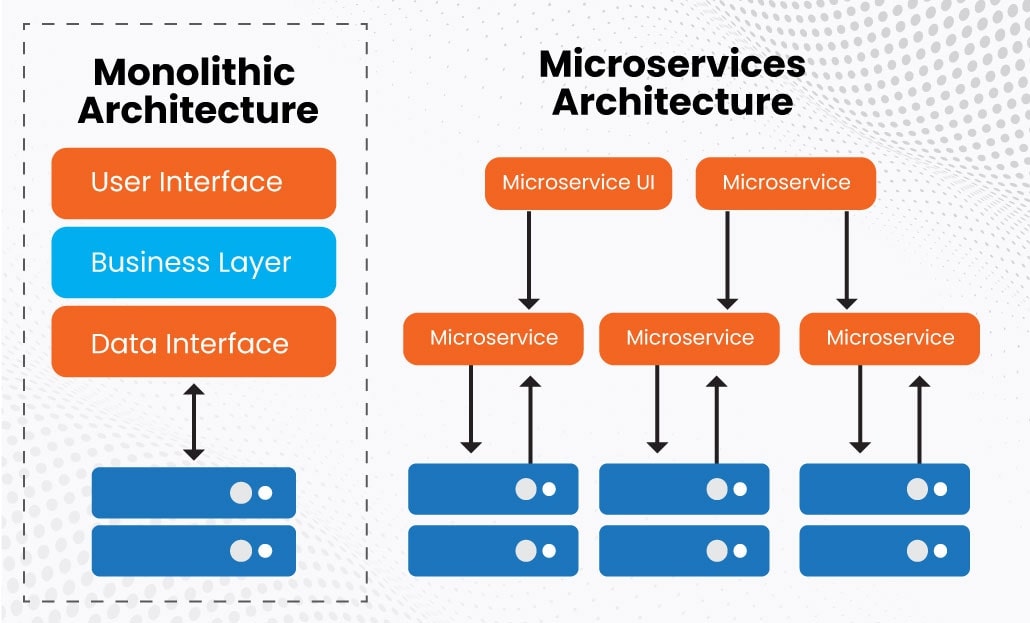
Choosing between monolithic and microservices architecture is not simply a technical decision. It affects development speed, infrastructure costs, application security, team structure, deployment frequency, system reliability, and long-term maintenance.
Microservices often receive more attention because they support independent deployment and selective scaling. However, that does not make them the right starting point for every application. A well-structured monolith can be faster to build, easier to test, less expensive to operate, and better suited to a small development team.
A business building a focused internal application may gain little from splitting the system into dozens of services. In contrast, an enterprise platform with several development teams, uneven workloads, strict availability targets, and frequent releases may struggle within a single deployment unit.
This guide explains the real differences between monolithic and microservices architecture, including their costs, performance characteristics, security implications, migration paths, and ideal use cases.
A monolithic architecture places the main functions of an application within one codebase and usually releases them as one deployment unit.
For example, an online procurement platform may include:
In a monolithic application, these capabilities may exist as separate modules, but they are built, tested, packaged, and deployed together.
A monolith does not automatically mean poor code quality. A properly designed monolith can contain clear modules, controlled dependencies, documented interfaces, automated tests, and strong security controls.
Problems usually begin when internal boundaries weaken. One module starts reading another module’s database tables directly. Business rules become scattered across the codebase. Small updates require broad regression testing. Eventually, teams cannot change one part of the system without assessing many unrelated areas.
AWS describes monolithic architecture as a model in which one codebase performs several business functions, while microservices divide software into smaller independent components. What Is Microservices Architecture?
A microservices architecture divides an application into independently deployable services. Each service normally owns a specific business capability, its related logic, and often its own data.
An e-commerce platform, for example, might have separate services for:
These services communicate through APIs, events, or messaging systems.
Microsoft recommends defining services around clear business capabilities and bounded contexts rather than creating services around technical layers such as controllers, databases, or user interfaces. goal is not to create the smallest possible services. The goal is to create useful boundaries that allow teams to develop, release, scale, and recover parts of the system with less coordination.
Microservices can support:
Independent deployment: A team can update one service without releasing the entire application.
Selective scaling: A heavily used service can receive more resources without scaling every application function.
Team autonomy: Cross-functional teams can own defined business capabilities from development through production support.
Technology flexibility: Services may use different technologies when a clear operational or business reason exists.
These benefits come with an important condition: the organisation must be able to operate a distributed system.
| Decision Area | Monolithic Architecture | Microservices Architecture |
|---|---|---|
| Code organisation | One main codebase | Multiple service codebases |
| Deployment | Application released as one unit | Services can be released independently |
| Initial development | Usually faster and simpler | Requires more architecture and platform work |
| Scaling | Entire application often scales together | Individual services can scale separately |
| Data model | Commonly uses a shared database | Services should own their data |
| Communication | In-process method calls | Network APIs, events, or messages |
| Testing | Easier end-to-end setup | Requires service, contract, integration, and system testing |
| Failure handling | One fault may affect the whole application | Failures can be isolated, but partial failure is expected |
| Operational needs | Lower at the beginning | Higher DevOps and observability requirements |
| Team fit | Small or centralised teams | Multiple cross-functional teams |
| Infrastructure cost | Usually lower initially | Often higher due to distributed components |
| Best suited to | Focused applications and early products | Complex platforms with independent domains |
The visible difference is the number of deployment units. The more important differences involve how the system handles change, data, failure, ownership, and operational responsibility.
Deployment boundaries
A monolith requires teams to coordinate around one release package. Even when developers change only one feature, the organisation may need to build, test, and deploy the full application.
Microservices allow independent releases, but only when service boundaries are genuine. Two services that must always be deployed together are not operationally independent. They may be a distributed version of one tightly coupled module.
Communication
Modules inside a monolith communicate through in-process function or method calls. These calls are usually fast and easier to trace.
Microservices communicate across a network. That introduces latency, timeouts, authentication, retries, version compatibility, message delivery problems, and partial failures. Microsoft warns that long chains of synchronous service calls can create network congestion and slow user requests. ata ownership**
A monolith often uses one relational database, which makes transactions and joins straightforward.
In a mature microservices design, each service controls its own data. Other services access that data through an API or event rather than reading the database directly.
This separation reduces schema coupling, but it makes cross-service reporting and transactions more difficult. Microservices often use eventual consistency because one database transaction cannot safely update several independently owned services. ailure behaviour**
A monolith commonly succeeds or fails as one running process. Strong internal error handling can limit some failures, but memory leaks, resource exhaustion, or deployment errors may affect the whole application.
Microservices can limit the impact of a failed component. However, they also create more failure points. A service may be healthy while its database, message broker, identity provider, downstream API, or network path is unavailable.
In distributed systems, teams must treat partial failure as an expected operating condition rather than an unusual event. Advantages of Monolithic Architecture
A monolith remains a strong choice when simplicity produces more business value than service independence.
Faster initial delivery
Developers can work in one repository, use one local environment, run one testing workflow, and deploy one application package. This reduces setup work during early development.
A small team can spend more time validating the product and less time managing infrastructure.
Simpler debugging
A request may remain inside one process from start to finish. Developers can trace execution without combining logs and traces from several services.
Lower operational overhead
A monolith may require fewer pipelines, dashboards, runtime environments, certificates, network policies, service accounts, and deployment configurations.
This can reduce both cloud spending and engineering workload.
Easier transactions
A shared database can support ACID transactions across several modules. This is useful when a workflow must update related records as one guaranteed operation.
Straightforward testing
Developers can run much of the application locally. Integration and end-to-end tests generally require fewer distributed dependencies.
Suitable performance for many systems
In-process calls usually have less overhead than remote calls. Applications with tightly connected workflows may perform well as a monolith because they avoid repeated network communication and data serialisation.
The main risks appear as the application, development team, and release workload grow.
Growing release risk
A change to one module may require rebuilding and retesting the complete application. The release package becomes larger, and unrelated teams may need to coordinate their changes.
Limited independent scaling
When one feature consumes most system resources, the organisation may still need to scale the complete application. This can waste infrastructure capacity.
Weak ownership boundaries
Several teams working in the same codebase may edit shared components. Without clear governance, ownership becomes unclear and changes create wider side effects.
Slower technology change
Replacing a framework, runtime, or database can affect the whole system. The organisation may postpone upgrades because the migration scope is too large.
Increasing cognitive load
As the codebase grows, developers need more time to understand dependencies. Onboarding becomes slower, and small modifications may require extensive regression testing.
These are not automatic failures of monolithic architecture. They are signals that the system may need stronger modularity or selective service extraction.
Microservices provide the greatest value when different parts of an application genuinely need to evolve, scale, or recover independently.
Independent releases
Teams can deploy one business capability without waiting for a coordinated application release. This can shorten release cycles when services have stable APIs and strong automated testing.
Flexible scalability
A business can scale a high-demand service separately. For example, a search or reporting service may need more compute resources than customer profile management.
Microsoft identifies independent scaling as a core microservices benefit because organisations can allocate resources to specific subsystems rather than the complete application. lear team ownership**
A cross-functional team can own a service’s code, database, deployment pipeline, monitoring, documentation, and production performance.
This model works best when services follow business domains and team responsibilities match those boundaries.
Fault isolation
A problem in a non-critical service does not always need to stop the complete application. A platform may temporarily disable recommendations or delay notifications while core ordering remains available.
Fault isolation still requires timeouts, circuit breakers, bounded retries, idempotent operations, and graceful degradation. It does not happen simply because the application uses microservices.
Focused modernisation
An organisation can replace or rebuild one capability without rewriting the complete platform. This is particularly useful for large legacy applications that cannot safely undergo a full replacement.
Microservices do not remove complexity. They move complexity from code structure into communication, data coordination, infrastructure, security, and operations.
AWS notes that microservices expose underlying complexity and provide a structure for managing it; they do not make that complexity disappear. igher operational cost**
Every service may need its own:
A platform team can standardise these needs, but building that platform requires skilled engineers and ongoing investment.
Harder troubleshooting
A single user action may pass through an API gateway, several services, a queue, a database, and an external provider.
Without centralised logging, distributed tracing, metrics, correlation identifiers, and service-level objectives, teams may struggle to identify the source of a problem.
Data consistency challenges
A business transaction may span several services. Since each service owns its database, a traditional distributed transaction may be impractical.
Teams may need event-driven workflows, compensating actions, idempotency, outbox patterns, reconciliation jobs, or sagas. These techniques require careful design and testing.
Network latency
Remote calls take longer than in-process calls. Chatty service designs can create slow requests and higher infrastructure consumption.
Larger security surface
Microservices create more APIs, service identities, credentials, network paths, workloads, and policies. Security teams must manage authentication and authorisation between services, not only between users and the application.
Versioning requirements
Services evolve at different speeds. An API or event change must not unexpectedly break its consumers. Backward compatibility and contract testing become part of normal delivery.
Specialist skill requirements
Teams need experience with distributed systems, CI/CD, cloud infrastructure, containers or serverless platforms, observability, API design, event processing, resiliency, and automated security controls.
Current Microsoft guidance recommends assessing DevOps maturity, infrastructure, team design, service boundaries, communication patterns, monitoring, and data ownership before adopting microservices. Is a Modular Monolith the Better Starting Point?
For many new applications, the best answer is neither an unstructured monolith nor immediate microservices. It is a modular monolith.
A modular monolith is deployed as one application but organised into business-focused modules with enforced internal boundaries.
For example, an application may contain separate modules for:
Each module owns its business rules and exposes a defined internal interface. Other modules cannot directly change its data or bypass its rules.
This structure gives a team much of the development simplicity of a monolith while preparing the application for future service extraction.
A modular monolith is often a good starting point when:
The architecture can later evolve. A module that develops distinct scaling, security, availability, or release needs can become an independent service.
This approach avoids paying the full distributed-system cost before the business has evidence that it needs microservices.
Neither architecture is automatically faster.
A monolith may produce lower latency because internal modules communicate within one process. It can also use efficient database joins and local transactions.
Microservices may improve performance when selected services require independent scaling or specialised infrastructure. However, each network call adds latency and another possible failure point.
Performance depends on:
A poorly divided microservices application may be slower than a well-designed monolith. It can also cost more because one user request activates several services.
Before choosing microservices for performance, teams should identify the actual constraint through load testing, application profiling, database analysis, and production telemetry.
Microservices provide a strong scaling advantage when application components have different resource profiles.
Suppose a public services platform contains case submission, identity verification, document processing, notifications, and analytics. Document processing may require significant CPU power, while notifications may experience short traffic spikes.
Microservices allow the organisation to scale those workloads separately.
A monolith can also scale horizontally by running multiple instances. That may be fully adequate when workloads grow at a similar rate.
The key question is not whether the application needs to scale. Most applications can scale as monoliths.
The key question is whether different capabilities need to scale independently enough to justify separate deployment and operation.
Security depends more on implementation, governance, identity controls, patching, testing, and monitoring than on the architecture label.
A monolith has fewer network interfaces and may be easier to protect initially. However, weak internal boundaries can give one compromised component broad access to application data.
Microservices can apply separate identities, permissions, network rules, and data controls to individual services. This supports least-privilege access.
At the same time, microservices increase the number of assets that need protection. Each service endpoint, workload identity, container image, secret, queue, API, and deployment pipeline becomes part of the security programme.
A secure microservices environment normally requires:
For government and regulated systems, the architecture should also support evidence collection, access reviews, configuration baselines, incident response, and documented recovery procedures.
A monolith usually has a lower initial cost because it needs fewer infrastructure components and less platform automation.
Microservices may improve the total cost of ownership for a mature, complex platform when independent deployments, targeted scaling, service ownership, and faster recovery create measurable business savings.
However, microservices can become more expensive when an organisation creates many small services without enough traffic, team scale, or release demand to justify them.
Costs may include:
The correct financial comparison should include engineering time and operational risk, not only cloud invoices.
A lower compute bill does not create savings when teams spend far more time diagnosing distributed failures.
A monolithic or modular monolithic architecture is usually the stronger option when the application has a focused scope, the team is small, and fast delivery matters more than independent deployment.
Choose it when:
AWS also identifies monolithic architecture as a practical option for new applications with limited complexity or scaling requirements. onolith is not a temporary failure. It can remain the right architecture for the full life of an application when it continues to meet business and operational targets.
Microservices become more suitable when organisational and technical boundaries already exist.
Choose microservices when:
The strongest reason to choose microservices is usually independent business change, not technology preference.
Before selecting an architecture, score the project across seven areas.
| Question | Monolith Favoured When | Microservices Favoured When |
|---|---|---|
| How many teams will build the system? | One or two teams | Several domain-aligned teams |
| How often must capabilities deploy? | Similar release schedules | Different, frequent schedules |
| How clear are the business domains? | Still being defined | Stable bounded contexts exist |
| How different are scaling needs? | Workloads scale together | Services have uneven demand |
| How mature is DevOps? | Basic automation | Mature CI/CD, IaC and monitoring |
| How complex are transactions? | Strong cross-module consistency | Eventual consistency is acceptable |
| What is the operating budget? | Limited platform capacity | Dedicated platform investment |
Do not make the decision from the total score alone. Some requirements carry more weight than others.
For example, independent release ownership may justify microservices even when traffic is moderate. A strict cross-domain transaction requirement may favour a monolith even when traffic is high.
Record the final decision in an architecture decision record. Document the context, options, trade-offs, assumptions, risks, and conditions that would trigger a future review. Microsoft’s current readiness guidance recommends maintaining architecture decision records with clear rationale and status. Common Architecture Selection Mistakes
Choosing microservices because large technology companies use them
Large platforms often have thousands of engineers, mature internal platforms, global traffic, and specialised operational teams. Their architecture solves problems that a smaller organisation may not have.
Creating one service for every database table
A service should represent a meaningful business capability, not an individual entity or technical function. Excessively small services increase communication, deployment, and monitoring work.
Sharing one database across every service
This preserves data coupling while adding network and deployment complexity. Teams end up with the disadvantages of both architectures.
Allowing unrestricted technology choices
Using a different language or database for every service can make hiring, security, support, and incident management harder. Technology diversity should solve a real need.
Migrating the full monolith at once
A full rewrite creates a long period in which the organisation maintains the existing system while building an unproven replacement.
Ignoring organisational structure
Microservices require clear ownership. A company with centralised approvals and shared component teams may not gain independent delivery simply by splitting the software.
Migration should begin with a business and operational reason, such as slow releases, scaling pressure, reliability problems, or a capability that needs independent ownership.
Start by improving the monolith. Add automated tests, clarify modules, identify dependencies, establish monitoring, and document data flows. Extracting services from an unstructured system without first understanding it can move hidden problems into a distributed environment.
Next, identify a capability with a clear boundary and limited dependency risk. Notifications, document generation, search, or reporting may offer useful starting points, depending on the application.
Place a controlled interface between the monolith and the new service. Route the relevant functionality through that interface while keeping the rest of the system operational.
Microsoft recommends incremental patterns such as the Strangler Fig pattern and an anti-corruption layer when decomposing an existing monolith. These methods allow the old and new architectures to operate together during migration. e data ownership carefully. Temporary shared databases may reduce initial migration risk, but they should not become an unplanned permanent dependency.
Measure the result after each extraction. Review deployment frequency, failure rate, recovery time, latency, infrastructure cost, support effort, and team productivity.
Do not continue splitting the application unless each new boundary produces a clear benefit.
Monolithic architecture is still suitable for many applications. A structured monolith can support reliable performance, automated deployment, cloud hosting, strong security, and long-term growth.
The problem is usually uncontrolled coupling rather than the use of one deployment unit.
Cloud platforms can host both monoliths and microservices. An application does not need microservices simply because it runs in the cloud.
Containers, managed databases, autoscaling, load balancing, and automated deployment can also support a monolithic application.
A monolithic application can scale vertically or horizontally. Multiple instances can run behind a load balancer.
Microservices become more useful when individual capabilities need different scaling strategies.
There is no ideal number. Each service should represent a useful business boundary and provide enough independence to justify its operational cost.
A system with ten clear services may be better designed than one with hundreds of tiny services.
Microservices can run on containers, serverless platforms, virtual machines, or managed application services. Kubernetes is one option, not a mandatory requirement.
The hosting platform should match the organisation’s scale, operational skills, compliance needs, and workload behaviour.
They can, particularly during migration, but a shared database creates coupling. Schema changes can affect several services, and teams cannot fully control their data.
The long-term goal should usually be clear data ownership, even when physical database separation happens gradually.
The main disadvantage is distributed-system complexity. Teams must manage network communication, partial failure, data consistency, service security, observability, deployment coordination, and infrastructure automation.
A modular monolith is often the practical starting point because it supports fast development and lower operating costs while preserving internal boundaries.
Microservices may be suitable when the startup already has several independent teams, proven scaling needs, or a platform made of clearly separate products.
Choose a monolithic architecture when simplicity, fast delivery, strong transactions, and low operational overhead provide the greatest value.
Use the form below to contact us about product information and pricing, customer feedback, stockholder services, or just to voice a concern.